Wardrobe Strategy
How to Make 15 Pieces Work for 30 Days
A practical month-long wardrobe experiment that proves you need less than you think.

Most people own between 50 and 100 garments. Most people wear about 20% of them regularly. That means the majority of your wardrobe is dead weight — pieces that take up space, slow down decisions, and create the illusion that you need more.
The 15-piece challenge strips that illusion away. For thirty days, you dress exclusively from fifteen garments. No shopping. No pulling from the rest of the closet. Just fifteen pieces and whatever combinations you can build from them. It sounds restrictive. In practice, it is the most clarifying wardrobe exercise you will ever do.
The Math Behind the Challenge
Fifteen sounds small until you count the combinations. If you select 5 tops, 3 bottoms, 2 layers, 3 shoes, and 2 accessories, the math opens up fast.
Five tops multiplied by three bottoms gives you 15 base outfits. Add two layering options and each base outfit triples — now you have 45 possible looks. Factor in three shoe choices and two accessories, and you are well past a hundred distinct combinations. You only need thirty.
The point is not to use all hundred. It is to understand that variety comes frominterchangeability, not from volume. A wardrobe of fifteen pieces that all work together produces more usable outfits than a wardrobe of fifty pieces that exist in isolated silos.
How to Pick Your Fifteen
The selection is everything. Get this right and the month will feel effortless. Get it wrong and you will be frustrated by day four.
The Formula
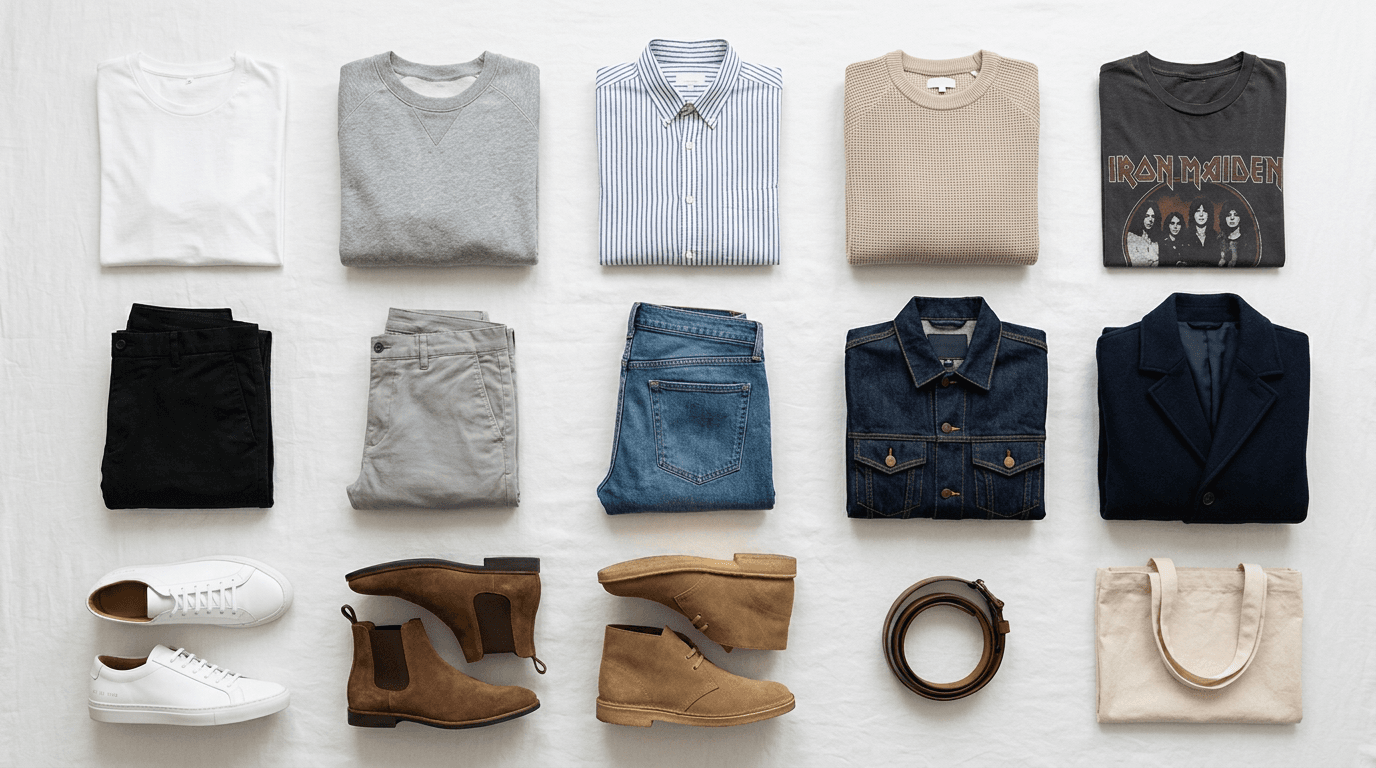
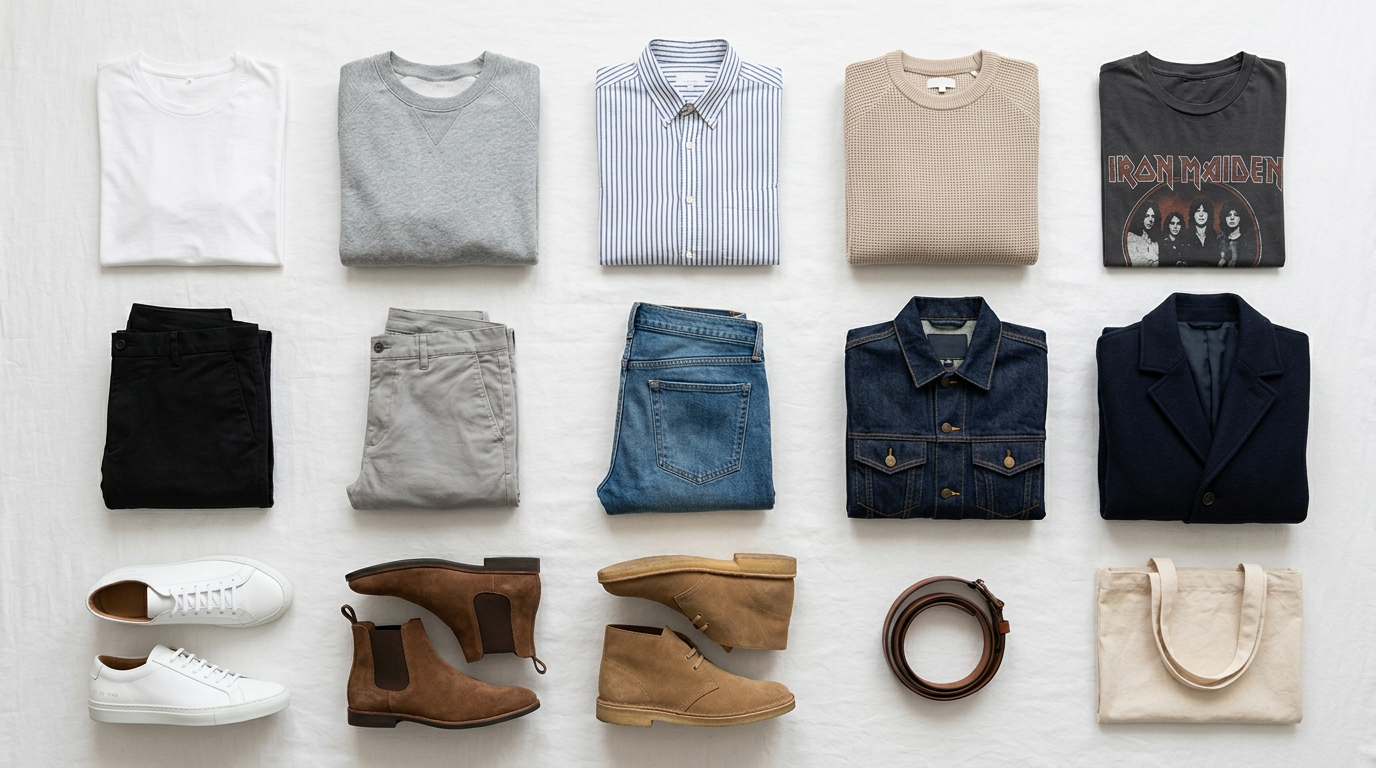
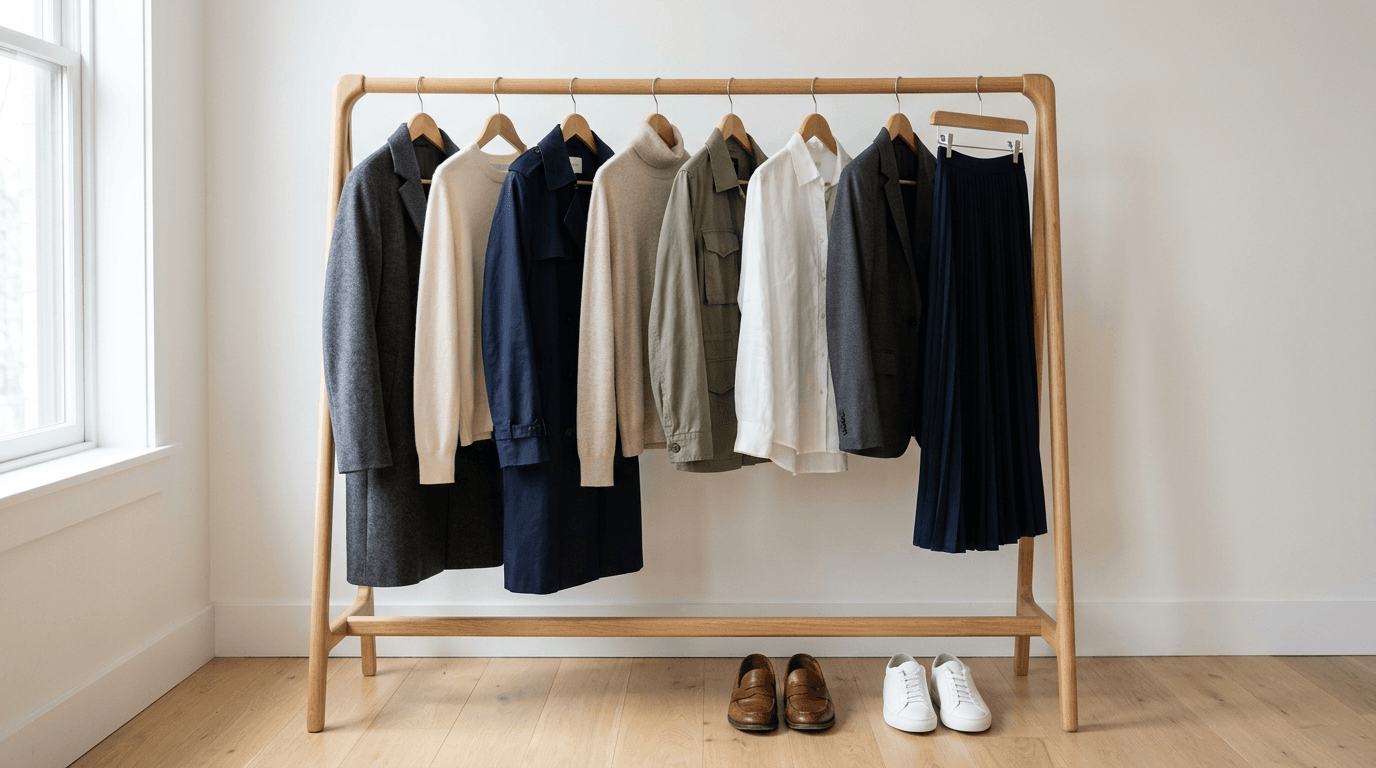
5 tops. Two neutral basics — white tee, grey crewneck. One pattern or texture piece — a striped shirt, a waffle knit. One button-down for dressier days. One wildcard that reflects your personality — a band tee, a bold colour, a favourite vintage piece.
3 bottoms. One dark pair — black trousers or dark denim. One lighter pair — grey chinos, light wash jeans, or a khaki. One versatile third — this could be a second denim in a different wash or a trouser that bridges casual and smart.
2 layers. One lightweight — a denim jacket, an overshirt, a cardigan. One warmer — a hoodie, a wool coat, a bomber. Together, they cover temperature range without duplication.
3 shoes. One clean casual — white sneakers. One slightly dressier — loafers, Chelsea boots, or desert boots. One weather-appropriate — boots for rain, trainers for active days. Shoes change an outfit's register more than any other single swap.
2 accessories. A belt and a bag, or a watch and a scarf, or whatever two items you reach for most. Accessories add variety without occupying a full garment slot.
The Cross-Test
Before locking in your fifteen, run the cross-test: every top must pair with every bottom. Every layer must work over every top. Every shoe must fit at least two-thirds of the combinations. If a piece only connects to one or two others, replace it. The strength of a small wardrobe is interconnection — one weak link drops your outfit count significantly.
The Combination Engine
Once your fifteen are chosen, the outfit-building follows three levers: tone,layer, and shoe register.
Shift the tone. The same white tee and dark jeans read casual with sneakers and relaxed with the sleeves cuffed. Swap the sneakers for Chelsea boots, add the button-down as an open layer, and the same two core pieces now read smart-casual. The garments did not change. The tonal framing did.
Add or remove a layer. A basic crewneck and chinos look simple on their own. Add the denim jacket and the outfit gains depth and texture. Remove the jacket and add the wool coat on a colder day — now the mood shifts entirely. Layering is the single fastest way to create a new outfit from the same base.
Change the shoes. This is the most underrated combination lever. White sneakers make everything lean casual. Loafers pull the same outfit toward polished. Boots add weight and edge. If you feel stuck mid-month, change the shoes before changing anything else.
Week-by-Week Strategy
Week 1: The obvious combinations. Start with the pairings that feel natural — the ones you would reach for instinctively. Do not force creativity yet. Let the challenge settle in. Photograph each outfit.
Week 2: The experiments. Now start pairing things you have not tried. The wildcard top with the dressier bottom. The lighter layer over a pattern. Some will miss. Most will surprise you. This is where the challenge starts teaching you something.
Week 3: The refinement. By now you know which pieces are doing the heavy lifting and which are sitting idle. If something has not been worn by day fifteen, ask why. Is it a colour mismatch? A fit issue? A mental block? The answer tells you something important about your real preferences.
Week 4: The insight. The final week is where the lessons land. You will notice that three or four pieces carry 80% of your outfits. You will notice that you did not miss the other forty pieces in your closet. You will have a clear map of what works, what does not, and what you actually need.
A digital wardrobe tool like Loryve can accelerate this entire process. Mapping your fifteen pieces visually, testing combinations before wearing them, and logging outfits daily — it turns the challenge from a mental exercise into a trackable experiment with real data.
What You Will Learn by Day Thirty
You need fewer clothes than you think. This is the obvious lesson, but it hits differently when you live it. Fifteen pieces is not a sacrifice — by week two, it feels like enough.
Versatility beats quantity. One piece that pairs with everything in your wardrobe is worth more than five pieces that each pair with one thing. The challenge makes this visible in a way that browsing your full closet never does.
Decision fatigue drops dramatically. Fewer options means faster mornings. When every combination works, the question stops being "what should I wear?" and becomes "which of these good options do I feel like today?" That shift is significant.
Your future purchases get smarter. After thirty days with fifteen pieces, you will never again buy something that only works with one outfit. The cross-test becomes second nature. Every new piece has to earn its place by connecting to the system, not just looking good in the store.
The 15-piece challenge is not a lifestyle commitment. It is a one-month diagnostic. Run it once, learn what it teaches, and let those lessons shape how you build, edit, and use your wardrobe from that point forward. The closet you come back to will feel like a different place — not because anything changed, but because you finally see what was always there.
Related articles
Wardrobe
A One-Hour Wardrobe Audit That Actually Works
A wardrobe audit does not need to take a weekend. With the right questions and no overthinking, you can clear the clutter and see what you actually own in under an hour.
Wardrobe
How to Build a Capsule Wardrobe That Actually Works
Most capsule wardrobe guides list the same 30 basics and call it done. Here is a system that starts with your actual life and builds outward from there.
Wardrobe Strategy
How to Stop Buying Clothes You Never Wear
Most wardrobes are full of things bought on impulse and worn once. Here is how to break the cycle with a few clear rules.